
Handhole Enclosure. These boxes can hold all types of devices. It should not be driven over by local traffic. It is not made for that. Local foot traffic yes not local car traffic.
“An enclosure for use in underground systems, provided with an open or closed bottom, and sized to allow personnel to reach into, but not enter, for the purpose of installing, operating, or maintaining equipment or wiring or both. (CMP-9)”
Hermetic Refrigerant Motor-Compressor. A motor and compressor with no exposed drive shaft.
“A combination consisting of a compressor and motor, both of which are enclosed in the same housing, with no external shaft or shaft seals, with the motor operating in the refrigerant. (CMP-11)”
Hermetically Sealed [as applied to Hazardous (Classified) Locations].
“Equipment sealed against the entrance of an external atmosphere where the seal is made by fusion, for example, soldering, brazing, welding, or the fusion of glass to metal. (CMP-14)
Informational Note: For further information, see ANSI/ ISA-12.12.01-2013, Nonincendive Electrical Equipment for Use in Class I and II, Division”
Hoistway. Back in the day there was a dumb waiter that you could use to transport your groceries to your floor and could unload it on your floor. Years later the garbage was sent down the garbage shut. The superintendent was able to send his tools to the floor that needed repair.
“Any shaftway, hatchway, well hole, or other vertical opening or space in which an elevator or dumbwaiter is designed to operate. (CMP-12)”
Hybrid System. Special attention needs to be payed when working on this system because the main panel can have constant power, even when the pubic utility power is out.
“A system comprised of multiple power sources. These power sources could include photovoltaic, wind, micro hydro generators, engine-driven generators, and others, but do not include electric power production and distribution network systems. Energy storage systems such as batteries, flywheels, or superconducting magnetic storage equipment do not constitute a power source for the purpose of this definition. The energy regenerated by an overhauling (descending) elevator does not constitute a power source for the purpose of this definition. (CMP-4)”
Identified (as applied to equipment). These labels have who is the maker of the product, the model number, serial number, amperage, required voltage, and so on. With this label you could figure out replacement parts, get the correct operational manual and more.
“Recognizable as suitable for the specific purpose, function, use, environment, applica‐tion, and so forth, where described in a particular Code requirement. (CMP-1)
Informational Note: Some examples of ways to determine suitability of equipment for a specific purpose, environment, or application include investigations by a qualified testing laboratory (listing and labeling), an inspection agency, or other organizations concerned with product evaluation.”
In Sight From (Within Sight From, Within Sight). We touched upon this when we described a disconnect. If the power cutoff is not within sight you need to do Lock out, tag out. To keep things safe the code uses this try to force the design of assembly.
“Where this Code specifies that one equipment shall be “in sight from,” “within sight from,” or “within sight of,” and so forth, another equipment, the specified equipment is to be visible and not more than 15 m (50 ft) distant from the other. (CMP-1)”
Industrial Control Panel. This is where the brains of the system call home. Remember that some industrial size equipment can have serval of these panels but only one place where the power is shut off.
“An assembly of two or more components consisting of one of the following: (1) power circuit components only, such as motor controllers, overload relays, fused disconnect switches, and circuit breakers; (2) control circuit components only, such as push buttons, pilot lights, selector switches, timers, switches, and control relays; (3) a combination of power and control circuit components. These components, with associated wiring and terminals, are moun‐ ted on, or contained within, an enclosure or mounted on a subpanel.
The industrial control panel does not include the controlled equipment. (CMP-11)”
Information Technology Equipment (ITE). Post production equipment can have many cables going to and coming from it. There are designers dedicated to this industry because of how complex’s theses devices are. So complex’s that some don’t talk to each other, so they don’t communicate correctly and needs to have a other devices to translate the information coming from and going to these devices.
“Equipment and systems rated 1000 volts or less, normally found in offices or other business establishments and similar environments classi‐ fied as ordinary locations, that are used for creation and manipulation of data, voice, video, and similar signals that are not communications equipment as defined in Part I of Article 100 and do not process communications circuits as defined in 800.2. (CMP-12)
Informational Note: For information on listing requirements for both information technology equipment and communications equipment, see UL 60950-1-2014, Information Technology Equip‐ ment — Safety — Part 1: General Requirements or UL 62368-1-2014, Audio/Video Information and Communication Technology Equipment”
Innerduct. Not normally used unless there are multiple voltages powering the device. The code is specific about this.
“A nonmetallic raceway placed within a larger raceway. (CMP-16)”
Interactive Inverter. This is principally used in renewable energy application where the devices feeds power back to the main panel. Normally those panels that are used to feed power to are clearly labeled so not to confuse it for the utility power.
“An inverter intended for use in parallel with an electric utility to supply common loads that may deliver power to the utility. (CMP-13)”
Interactive System. So you don’t normally see this unless there are multiple power sources that feed the same device. It references a redundant system that feeds a critical load. This requires some knowledge of the system that is being worked on just so that you know where the power is coming from and know how to shut off the system if a problem does arise.
“An electric power production system that is operating in parallel with and capable of delivering energy to an electric primary source supply system. (CMP-4)”
Interrupting Rating. When a breaker trips because the circuit goes in to over current conditions that is not a good thing. It means a couple of things are happening. One is the device to not being used in the way it was designed, or the motor is failing. This allows us to replace the parts not the whole device. This saves use money not just by protecting the devices interior circuits, but it also protects the wiring in the walls by not allowing the plastic coating to melt. This is the bread and butter of this book. The core of this is to save life’s and property.
“The highest current at rated voltage that a device is identified to interrupt under standard test conditions. (CMP-10)
Informational Note: Equipment intended to interrupt current at other than fault levels may have its interrupting rating implied in other ratings, such as horsepower or locked rotor current.”
Intersystem Bonding Termination. This is used to ground the cable and telephone lines that are connected to your home. It resides outside your home usually by the meter pan.
“A device that provides a means for connecting intersystem bonding conductors for communications systems to the grounding electrode system. (CMP-16)”
Intrinsically Safe Apparatus. Now I am not perfect, I don’t pretend to be. But your not suppose to use the same word in the definition. Intrinsically mean a natural way of being. So in it’s normal state the device(apparatus) is safe when wired as required.
“Apparatus in which all the circuits are intrinsically safe. (CMP-14)”
Intrinsically Safe System [as applied to Hazardous (Classified) Locations]. This is what we want to creat, so that it becomes automatically safe as long as no one changes the wiring to the system. This is the best example of what a correctly wired safe system looks like.
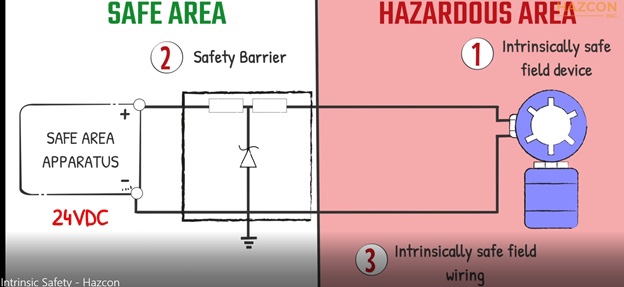
“An assembly of interconnected intrinsically safe apparatus, associated apparatus, and interconnecting cables, in that those parts of the system that may be used in hazardous (classified) locations are intrinsically safe circuits. (CMP-14)
Informational Note: An intrinsically safe system may include more than one intrinsically safe circuit.”
Isolated (as applied to location). So OSHA loves this word. When devices are isolated the personnel will not be able to access to dangerous areas of the device.
“Not readily accessible to persons unless special means for access are used. (CMP-1)”
Kitchen. A place in a home where food id prepared and cooked.
“An area with a sink and permanent provisions for food preparation and cooking. (CMP-2)”
 The Electrical Code
Leave a comment