
Part II. Over 1000 Volts, Nominal
Electronically Actuated Fuse. I hope you don’t ever deal with this situation and are looking at this blog for answers on how to handle 1000 volts or more. This blog does have the exact words the code uses to enforce the rules to keep us and our property safe. That will scare the shit out of me. At any rate we need to understand that at these voltages the danger rises substantially. We need to understand how things work in this situation is not the same as when we deal with 480 volts or less. Voltages in this situation needs to be shut down no questions asked and when testing there needs special personnel protective equipment(PPE). The code goes through this. Again I hope your not looking for answers from this blog when working on these voltages. God bless.
“An overcurrent protective device that generally consists of a control module that provides current sensing, electronically derived time–current characteristics, energy to initiate tripping, and an interrupting module that interrupts current when an overcurrent occurs. Electronically actuated fuses may or may not operate in a current- limiting fashion, depending on the type of control selected. (CMP-10)”
Fuse. At these voltages we are not dealing with normal fuses that we can get locally. Usually we need to get them from a electrical supply house. Power needs to be interrupted by your local utility before working on these circuits. Again I hope I don’t need to say this.
“An overcurrent protective device with a circuit-opening fusible part that is heated and severed by the passage of overcurrent through it. (CMP-10)
Informational Note: A fuse comprises all the parts that form a unit capable of performing the prescribed functions. It may or may not be the complete device necessary to connect it into an electrical circuit.
Controlled Vented Power Fuse. This type of fuse is used in switching yards around the country. This fuse is used when voltage is over 1000 volts.
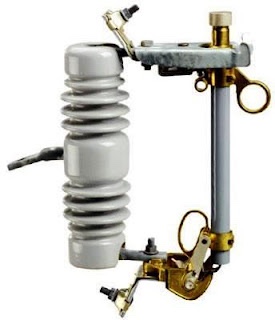
A fuse with provision for controlling discharge circuit interruption such that no solid material may be exhausted into the surrounding atmosphere.
Informational Note: The fuse is designed so that discharged gases will not ignite or damage insulation in the path of the discharge or propagate a flashover to or between grounded members or conduction members in the path of the discharge where the distance between the vent and such insulation or conduction members conforms to manufacturer’s recommendations.
Expulsion Fuse Unit (Expulsion Fuse). A vented fuse unit in which the expulsion effect of gases produced by the arc and lining of the fuseholder, either alone or aided by a spring, extinguishes the arc.
Nonvented Power Fuse. A fuse without intentional provision for the escape of arc gases, liquids, or solid particles to the atmos‐ phere during circuit interruption.
Power Fuse Unit. A vented, nonvented, or controlled vented fuse unit in which the arc is extinguished by being drawn through solid material, granular material, or liquid, either alone or aided by a spring.
Vented Power Fuse. A fuse with provision for the escape of arc gases, liquids, or solid particles to the surrounding atmosphere during circuit interruption.”
Substation. This place allows electrical energy go through it and has other avenues to reroute electrical energy to those branch circuits.
“An assemblage of equipment (e.g., switches, interrupting devices, circuit breakers, buses, and transformers) through which electric energy is passed for the purpose of distribution, switching, or modifying its characteristics. (CMP-9)”
Switching Device. This is pretty self explanatory, a switch that interrupts the power(opens) and when needed connects the power(closes) to turn on the power. The following are examples of devices that connect(close) and break(opens) the connection.
“A device designed to close, open, or both, one or more electrical circuits. (CMP-1)
Circuit Breaker. A switching device capable of making, carrying, and interrupting currents under normal circuit conditions, and also of making, carrying for a specified time, and interrupting currents under specified abnormal circuit conditions, such as those of short circuit.
Cutout. An assembly of a fuse support with either a fuseholder, fuse carrier, or disconnecting blade. The fuseholder or fuse carrier may include a conducting element (fuse link) or may act as the disconnecting blade by the inclusion of a nonfusible member.
Disconnecting Means. A device, group of devices, or other means whereby the conductors of a circuit can be disconnected from their source of supply.
Disconnecting (or Isolating) Switch (Disconnector, Isolator). A mechanical switching device used for isolating a circuit or equipment from a source of power.
Interrupter Switch. A switch capable of making, carrying, and interrupting specified currents.
Oil Cutout (Oil-Filled Cutout). A cutout in which all or part of the fuse support and its fuse link or disconnecting blade is moun‐ ted in oil with complete immersion of the contacts and the fusi‐ ble portion of the conducting element (fuse link) so that arc interruption by severing of the fuse link or by opening of the contacts will occur under oil.
Oil Switch. A switch having contacts that operate under oil (or askarel or other suitable liquid).
Regulator Bypass Switch. A specific device or combination of devices designed to bypass a regulator.”
 The Electrical Code
Leave a comment